A custom-printed cornhole bag has to do two jobs at once. It has to carry a logo, a team name, or a wedding date that looks sharp from across the yard, and it still has to fly and slide like a real bag. Buyers who care about the second job almost always ask the same thing before they order: will a printed bag still count as regulation? The short answer is that branding and legality are two separate questions. What makes a bag tournament-legal is its construction, not its artwork.
The four numbers that define a regulation bag
The American Cornhole League standard is refreshingly specific, which makes it easy to hold a supplier to. A regulation bag is 6 inches square. It weighs between 15.5 and 16.5 ounces, so a full set of eight lands right around a pound each with a small tolerance on either side. It is filled with plastic resin pellets in the modern game, though traditional whole-corn fill is still legal for casual play; resin is preferred because it shrugs off moisture and holds its weight over a season instead of breaking down. And competition bags are dual-sided, pairing one grippy face for stopping a bag on the board with one slick face for sliding it up and through the hole.
Those four attributes, size, weight, fill, and the two-faced fabric, are the whole physical definition. A board, for context, is 48 inches long and 24 inches wide with a 6-inch hole set 9 inches down from the top, the back edge sits about 12 inches off the ground, and the two boards are pitched 27 feet apart front edge to front edge. The bag is built to that geometry, which is why the weight and size windows are so tight.
Where the Pro and Comp stamp actually matters
For sanctioned play, hitting the specs is not quite enough on its own. The ACL publishes an approved-bag list, and for the 2026 season that list runs to roughly 350 individual models across more than two dozen manufacturers. A bag on that list carries a printed Pro or Comp stamp that tells a tournament director it was submitted and cleared. If you are playing in an ACL-sanctioned event, a stamped model is the requirement, full stop.
The important thing for a custom buyer to understand is that most people are not playing sanctioned events. League nights at a bar, a company tournament, a tailgate, a backyard bracket, none of that requires a stamped bag. It requires a bag that plays fairly and consistently, which a well-made 6-by-6, 16-ounce dual-sided bag does whether or not it ever went through the approval process. Knowing which world you are buying for is the single decision that shapes the rest of the order.
Printing doesn’t break the rules, construction does
Here is the part that surprises people. The approval process evaluates a specific bag model, its fabric, its fill, its dimensions, as a fixed product. Adding your own artwork to that exact model generally happens through the manufacturer’s own program, because a stamp certifies the thing that was tested, not a version someone modified afterward. So if your goal is a stamped, sanctioned-legal bag with your logo, you are usually working within an approved maker’s customization option rather than printing onto a stamped bag yourself.
For everything else, custom printing is wide open and does not compromise play at all. Sublimation, the most common method, dyes the image into the fabric so there is no raised layer to change how the bag slides; the printed face feels the same as an unprinted one of the same cloth. That is exactly why sublimated bags are the default for branded and novelty orders. The trap to avoid is a heavy screen print or a thick vinyl transfer on the sliding face, which can add a patch of drag the rest of the bag does not have. Keep decoration off the slick face, or use a method that sits in the fabric rather than on top of it, and a custom bag plays like any other.
Speed: the spec that isn’t in the rulebook
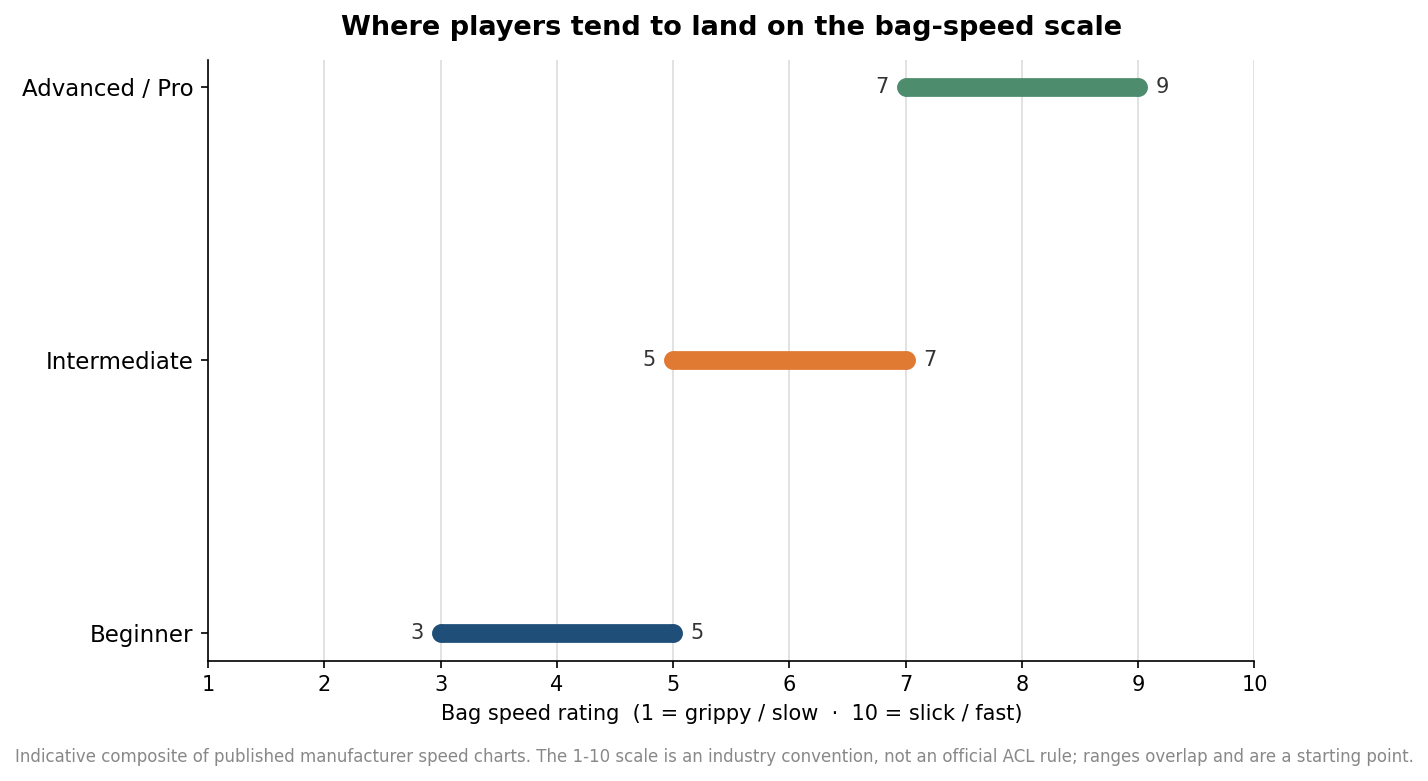
The ACL defines size and weight, but it does not assign a speed number. Speed is an industry convention, usually a 1-to-10 scale where 1 is a grippy bag that grabs the board and 10 is a slick bag that slides fast. It comes entirely from the fabric on each face and, to a lesser degree, the fill. Because a competition bag has two faces, most bags are really two numbers, a slow side and a fast side, and players flip the bag depending on whether they are trying to block or trying to slide through a jam.
Skill level tends to track with preference. Newer players usually do better with slower, grippier bags that stop where they land and forgive an overthrow, while experienced players lean on faster faces to push and roll bags with intent. None of this is a hard rule, and the ranges overlap heavily, but it is a useful starting point when you are choosing what to order.
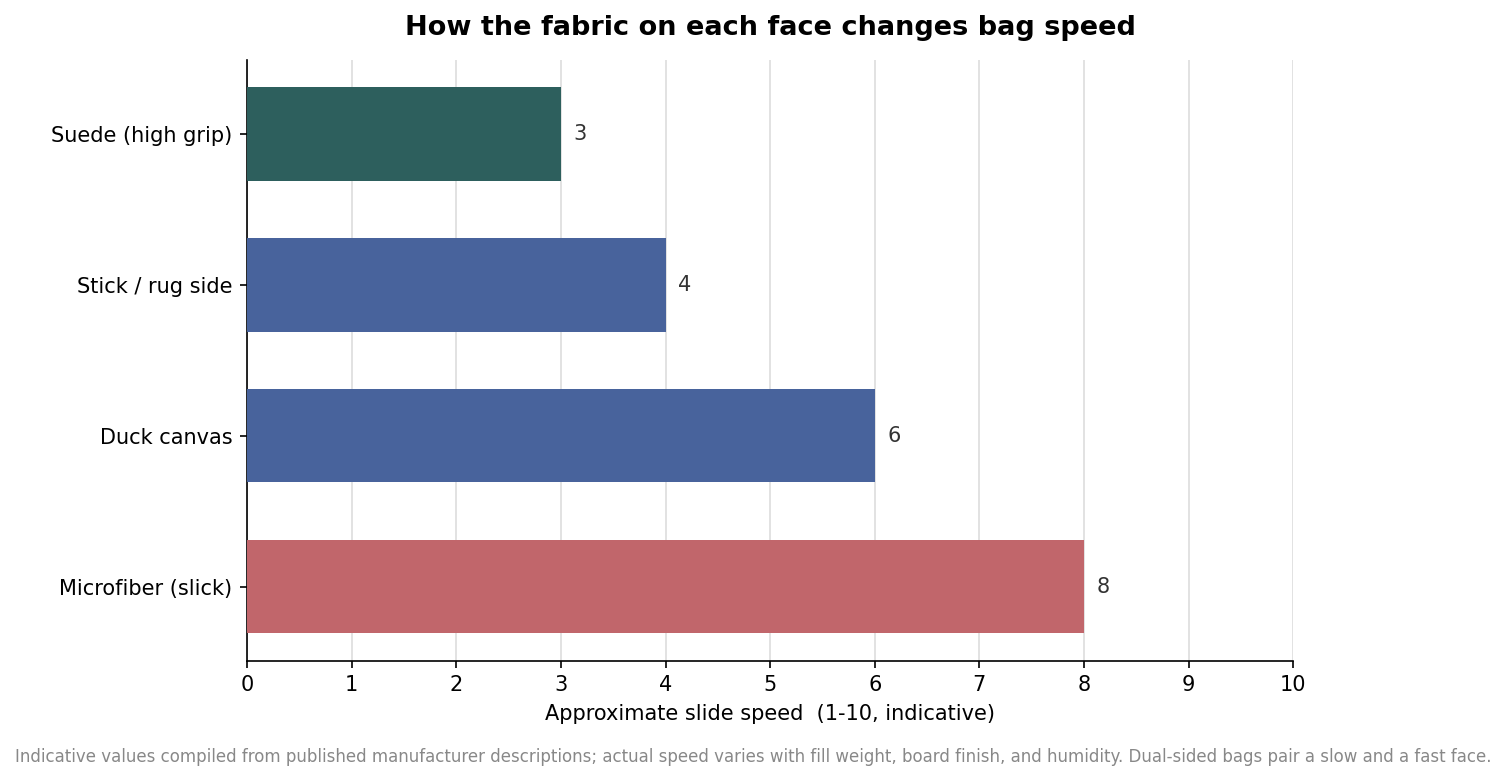
Fabric is where speed really comes from. Suede and similar napped materials grip hard and sit at the slow end. Duck canvas lands in the middle with a moderate, controllable slide. Slick microfiber and coated fabrics run fast. Fill weight nudges the number too, since a heavier bag within the legal window resists sliding a touch more than a lighter one.
How to spec a custom order that plays right
Start by naming the use. If any part of the answer is sanctioned ACL play, specify a stamped, approved model and get your branding through that maker’s program; do not improvise. If the answer is league, corporate, event, or backyard, you have full freedom on artwork and should focus the spec sheet on the four physical numbers: 6 by 6 inches, 15.5 to 16.5 ounces, dual-sided fabric, resin fill. Ask the supplier to confirm each of those in writing rather than assuming, because the cheapest novelty bags often cut the weight or use a single fabric on both faces, which plays flat.
Choose your fabrics deliberately: a grippy face and a slick face if you want true competition feel, or a single medium fabric like duck canvas if the bags are mostly for casual fun and you would rather not explain flipping to a crowd. As a rough guide, blank competition-grade sets tend to run in the low tens of dollars per set of eight, and custom sublimated sets sit above that depending on quantity and print coverage, with typical turnaround for decorated bags landing somewhere in the one-to-three-week range; treat those as indicative, since they move with order size and season. Finally, plan a short break-in. New bags, especially resin-filled ones, play a little stiff for the first few dozen throws and settle into their rated speed once the fill loosens and the fabric relaxes.
Get the four numbers right, keep decoration in the fabric instead of on top of it, and a custom bag can look like nothing else on the field while still playing exactly like the rulebook intends.